Here I am at the zoo, working on my laptop while my son and his sitter are off enjoying themselves. I’m only here because I needed to give them a ride so why not enjoy the sounds of confined nature while outdoors and getting some work done? I had just finished my lunch and started working when a white woman walks up to me asking if I was going to be done anytime soon. I was v clear with her that I wasn’t going to be done anytime soon. She then decided that it would be worth it to start shaming me loudly for being rude to not give up my table for her and her family who paid to eat in a public space. She even took liberty to shame me even more for having popcorn on the side for not being a legit reason for me to be allowed in this space. Mind you, literally 2 minutes later, a table opened up for her entire family. It might’ve been less but she’s seated and happy as a clam, moved on from the public shame she inflicted on me, while I sit here wounded and PISSED for her drive by shaming and white violence. I only say violence because my body was shaking, and I could feel my throat close up, my ears getting hot, and tears welling up. But I refuse to give that to her.
And so the spiral of shame hit me hard mixed in with my own internal rage against this fellow MOM who is trying to survive in this pandemic by sending our kids to the few outdoor places that give them joy. Racial trauma asks the question: was I selfish for not giving up my seat for this family? Was I wrong in my tone of voice for saying v firmly that I wasn’t going to be moving anytime soon? Was it wrong for me to be working in a public cafeteria while my kid is enjoying the zoo?
I have to say a resounding HELL NO. My body knew that I didn’t owe this woman anything before she even spoke a word to me which was why I was firm and clear in my response about not moving. Her white backlash was real because I didn’t act in her favor. And I guess I didn’t expect her react that strongly either, but white women gonna be white. I just got hella Karen’ed. She used her voice to signal to the public to police my actions. And it worked because the table next to me remarked at my rudeness. That’s another thing. Who is WORTH being in this space or any space? Here are some capitalistic white supremacist bull crap that came into play:
*Because she paid for the zoo’s food, she gets to claim the space that I’m in. I am not allowed to eat my home brought popcorn. She has more value for putting money into the zoo establishment. *Because she had more people in her party, I had to move bc I was alone and unworthy to be in this space regardless of how I was using it. It didn’t matter to her what I was doing or why I was even there. She dehumanized me by name calling me as rude and selfish.
Isn’t that something?
Isn’t that how colonialism works?
Of course she shamed the fuck out of me in a public space. But white women and people do this shit ALL the fucking time since the BEGINNING of time. Oh, you don’t have the intellectual wit and vigor that we Europeans hold? COLONIZED. You don’t subscribe to our superior ways of life? COLONIZED. You won’t move out of the land that we ‘discovered’? COLONIZED. You don’t have economic paper goods to prove your worth? COLONIZED.
White people take and use up ALL the space and if BIPOC are not giving anything up easily, white folks resort to VIOLENCE. So barbaric. So dehumanizing. What’s worse is that I saw her adolescent white son watch ALL of it. This is how white children are GROOMED to uphold and sustain white supremacy. They watch white parents and mimic these same violent behavior and actions committed against BIPOC wielding their white privilege and entitlement around as if it’s their God given right.
Thank god for my kin folk who supported me in my rage. Here was some help I received in the moment when I didn’t know what to do with all the rage and shame I felt:
Close your eyes for a second and name the feeling. Respect and hear the feelings. Thank the feeling for protecting you and listen for what it wants to communicate. Decide if you want to act on the feeling or set it aside for later.
So here I am writing my emotions. As I meditated, I remembered the stories of our indigenous family. What kept me grounded was the reality that this interaction was colonialist at its root. Maybe that’s not the correct term and in no way am I trying to minimize the genocide and enslavement our black and indigenous family experience(d). But the behavior and mindset are the same.
We are living in a time where we’re witnessing a sharp conflict of defending Asian people’s experience of racism, and this is yet another example of Asians experiencing erasure. I could have just let this experience die inside of me while she felt vindicated to move on with ease and no consequence. But I’m writing this now to scream it out to the virtual world that this is racism in its subtlest forms. This is a DAILY experience that BIPOC go through and we need to name these violent acts. We are NOT having it. Our people’s experiences are WORTH being validated, seen, and understood. We deserve to be at the table and we will not submit to white supremacy by giving them our place at the table.
White dominant work culture is toxic in many ways… here are some ways that you may see it in your workplace!
For one, White dominant work culture does not understand intersectionality. It does a terrible job of holding contradictory feelings and thoughts simultaneously and instead resorts to Black and White thinking (pun intended). This often will lead to the erasure of other voices and opinions that don’t fit in dualities.
It prioritizes competition over collaboration. Staff compete in a flimsy”meritocracy” in order to get fair wages, raises, and benefits but no one points out the implicit/explicit bias involved in making these decisions.
Leadership hoards power and gate keeps information. Information and decision making processes are confidential rather than transparent for all levels of an organization in order to maintain absolute control. Bottom line: they make it as difficult to unionize as possible.
Non-dominant ways of dressing, working, thinking, speaking, or being is dismissed as “unprofessional”. Wearing a button up shirt is professional and wearing a tie is super professional, but wearing “cultural apparel” is not professional and is relegated as a costume to be worn around October 31st. Being exploited for your labor by having to respond to your boss at 11pm because he forgot about an assignment is professional, but getting sick, pregnant, or leaving a meeting that is running 10 minutes late to pick up your kid from daycare is unprofessional. Hierarchy as outlined through org charts is professional. Shared power is not. Sounding matter-of-fact is professional. Admitting doubt is not.
What are some ways you see toxic dominant work culture in your workplace?
Disclaimer: SPOILER ALERT! The following contains spoilers for the movie Moonlit Winter.
Moonlit Winter (윤희에게, 2019) is a South Korean film directed by Lim Dae-hyung, which world-premiered as the closing film at the 24th Busan International Film Festival. Moonlit Winter follows the story of four women, Yoon-hee, Yoon-hee’s daughter Sae-bom, Jun, and Jun’s aunt Masako. Through a poetic and somewhat reserved visual language, the film traces how two middle aged women Jun and Yoon-hee, with interventions from Sea-bom and Masako, re-excavate and re-encounter their romantic connection from their adolescent years, which had been thwarted because it did not conform to heteronormativity. I loved that the film looks at women’s relationships, sometimes across generations, and that it has middle aged women as its main characters. The imageries that stood out to me were moons, sea, train, snow, hugs, letters, photos, women smoking, and women beholding women, whether it was through a camera or through the naked eyes.
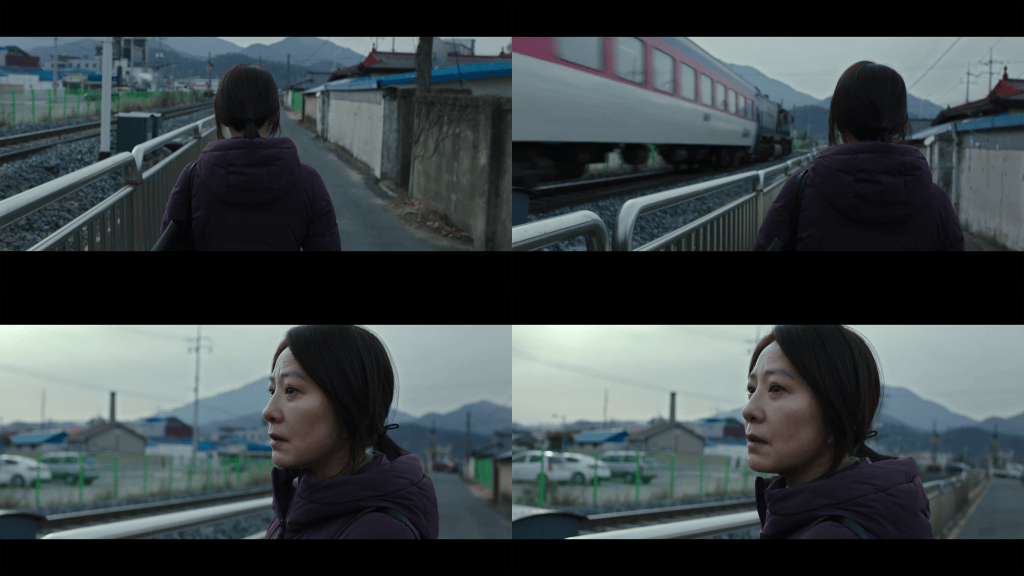
At first I had trouble immersing myself into the film, because I felt the acting was a bit affected. However. this might also be me because oftentimes it takes me time to become immersed into the world of a film. I usually have a moment that I feel invited into the world of the film. For Moonlit Winter, it was the moment when Yoon-hee walks past a train track, and is awakened by a train that passes by, as though the train reminded her of something important.
A train passes by Yoon-hee as she walks along a train track, reminding her of something important that she had forgotten about for a long time. (19min 00sec, Moonlit Winter 윤희에게)
The train track scene is the pivot point that turns the time backwards to the funeral service for Jun’s father, which is the incident that prompted Jun to write a letter to Yoon-hee. The train track scene is one of the rare instances that shaky camerawork is intentionally used in the movie, which otherwise sticks with tranquil frames.
Jun and Masako returning from the funeral, enduring Ryusuke’s well-intentioned chatter. (Moonlit Winter 윤희에게)
The two male characters of the film, Yoon-hee’s ex-husband and Ryuske, who drives Jun and Masako back from the funeral, are both well-intentioned, overbearing and clueless, oftentimes offering unwelcome help or gifts. They are both concerned and tender-hearted, but clueless as to what Yoon-hee or Jun is going through. Therefore their well-intentioned offers of vitamins and a blind date all come across as nuisance to Yoon-hee and Jun, invoking angry rejections on their part.
Jun decides to walk home after trying to put up with Ryusuke’s chatter. (Moonlit Winter 윤희에게)
On the way back from her father’s funeral, Jun calls one of her clients from her veterinarian hospital, with whom she seems to have maintained a friendly flirtatious vibe. The two walk home together and look up at the decrescent moon. The client suggests having a drink together and Jun agrees.
When Jun returns home, Masako, who has become emotional in the wake of her brother’s death, who is also Jun’s father, asks Jun to give her a hug. Jun, at first is taken aback by the unprecedented request, but soon the two women embrace each other and make space for their tender grief to flow.
Masako baffles Jun at first with her unusual request for a hug. (Moonlit Winter 윤희에게)
At home, Jun writes the fateful letter to Yoon-hee, which, in the letter she states that she has written numerous times and have not once been able to send, because Yoon-hee is married and with a family; because an interjection of homoromantic feelings would disrupt the heteronormative institution, and this is not allowed. Therefore each letter, she writes, would be written as though she was writing Yoon-hee for the first time, because there was so much that she wanted to say that would accumulate within her, unspoken. In this letter she writes, that Yoon-hee was someone that she had longed for, that through their encounter, she was able to know who she was.
This letter was bound to stay captive somewhere in Jun’s room full of memories, however, Masako, who understood the entire situation starting from Jun and Yoon-hee’s forbidden teen romance, and who has watched numerous letters to Yoon-hee vanish into oblivion, intervened and put the letter in the mail box. (This happens in the very beginning of the movie.)
Throughout the movie, Masako repeats the phrase “Yuki ha itsu yamu no kashira (When will the snow stop falling? 눈이 언제쯤 그치려나?)” like a mantra. To me it sounded like an expression of a perpetual state of waiting. Masako is not only the supportive and empathetic aunt, but she also runs a small coffee shop that sells pastries, therefore she is an independent business woman, who is able to support herself and create a comfortable environment and routine for herself. After she closes for the day, Masako’s routine is to spend some time reading SF novels in the corner of her cafe, until Jun drops by to walk home with her. Even though she takes on a supporting role in the film, it is clear that she is an independent woman capable of creating and negotiating her own world, even if it meant that she was in a state of suspension. Perhaps her interest in SF novels reflected her interest in the world that is beyond her reach in real life. If it is a state of suspension and waiting that she is, it is a suspension that is teeming with not only exquisite, quaint, and rich everyday experiences, but also possibilities and imaginations.
Therefore, Masako is a woman who knows who she is and has found a negotiation point with the world that is safe and enriching for her and her loved ones. Yet, her mantra “When will the snow stop falling?” leaves us with the sense that perhaps, like her niece’s homoromantic desires, there is a part of her that has been shut down, that she hasn’t been able to express or live out. It makes me wonder, what is her story, that even the movie did not have the space to tell?
On the other hand, in Korea, Jun’s letter that was sent by Masako stirrs up deep waters for Yoon-hee and Sae-bom. They both separately revisit Yoon-hee’s photo album that contains photos from her teen years, Yoon-hee in an attempt to recover pieces of herself that has been suppressed and put away for a long time, and Sae-bom motivated by the desire to understand her mother.
Sae-bom, being a precocious teen, quickly figures out the mysterious reasons for her mother’s unhappy marriage and divorce, which brought her to this world, but meant giving up a part of herself to Yoon-hee. Like Masako, Yoon-hee negotiated with the world to find a balance in her life, however Sae-bom saw through the fragile veneer of that balance. She tells her mom, who she assumes to be asleep, that she chose to live with Yoon-hee at the time of the divorce, because she felt that Yoon-hee would not be able to live by herself. With the clandestine motivation to facilitate Yoon-hee and Jun’s encounter, Sae-bom suggests a trip to Japan.
Jun’s letter had moved Yoon-hee enough that she agrees to travel to Otaru, the town that Jun lives in. Yoon-hee works as a kitchen staff, and when her boss responds rudely to her request to use her accumulated off-days, which she hasn’t used once, Yoon-hee decides to leave her job. She chose to recover a long-lost part of her soul over the stability of a frustrating job.
Yoon-hee seems more light-hearted as she leaves her job for the last time. And daughter and mother behold each other as they travel by train next to the ocean.
Once they arrive in Japan, mother and daughter spend time together, going to hot springs, dining at restaurants, and looking at the full moon. Notably, Yoon-hee borrows light from Sae-bom at one point, which was a tacit acknowledgement of Sae-bom’s budding adulthood. Sae-bom takes a photo of her mother smoking, even though Yoon-hee told her not to, saying that she is beautiful. Sae-bom is happy to see her mother blossoming, to see light returning to her eyes.
In the meanwhile, Yoon-hee visits a bar by herself and chit-chats with the bar tender.
Yoon-hee visits a bar by herself and smokes a cigarette. (Moonlit Winter ㅇ유윤윦윤희에게)
And Jun goes for a drink with her client, who subtly flirts with her, to which Jun responds somewhat firmly by saying, “look, it takes me courage to say this, but I’ll say it. I never told anyone that my mother is Korean, because no good comes out of it. Similarly, if there is something that you have not ever told anyone, it is better to keep it that way.” Jun alludes to the negotiations she had to make in terms of her ethnicity and sexuality, and the choice she made to conform to normativity. Like Masako, she created a balance for herself by staying single and becoming a veterinarian. She chose to be smart, but it came with an expense. (Notice the cigarette in Jun’s hand.)
Jun carefully but firmly suggests that they conform to normativity. (Moonlit Winter 윤흐희힁희에게)
At home Masako and Jun revisit Jun’s photo from her teen years which Yoon-hee took for her. Enclosed in a floral frame, this photo is a link to a piece of herself that Jun preciously carries, a doorway to treasured memories and a satisfactory sense of self.
Jun and Masako shovel snow together and look up at the moon. It seems that there is nothing auntie and niece cannot tackle on their own together.
In the meanwhile, Sae-bom intervenes again and meets with Masako at her coffee shop, and asks for a meeting with Jun. When she meets with Jun, Sae-bom asks her to have dinner with her the next day, which is her last day in Japan. In the meanwhile, Sae-bom also asks Yoon-hee to meet with her in the same place at the same time.
Through Sae-bom’s intervention, Jun and Yoon-hee run into each other and spend the evening together, recovering lost pieces of themselves. Sae-bom watches this from a far, then hugs her boyfriend under the full moon who has been her secret accomplice.
Finally Jun and Yoon-hee meet again! Their long suppressed love and feelings for each other are able to be expressed, and it is this moment of expression that lights up their souls and gives them inspiration to live. Being true to oneself, one’s feelings and desires are intrinsic to the resolution that the psyche so strongly desires, and when this resolution happens, one is able to reinvent oneself and continue to live, perhaps on a different, novel plane.
After returning from their trip to Japan, Yoon-hee decides to apply for a new job, opening a new terrain, and the mother-daughter relationship seems to be less strained. After the resolution, there is a light-heartedness about both Yoon-hee and Sae-bom. Sae-bom takes a photo of her mother as Yoon-hee walks into a restaurant for a job interview. Mother and daughter behold each other, reflecting back to each other a renewed self that is in touch with who she is.
Some say children are most adorable when they are asleep. (Moonlit Winter 윤희에게)
After watching the film Moonlit Winter, I felt a sort of cleansing of the heart. The only question I had was, why do most queer narratives involve impossible relationships, due to differences such as class, race or age? This renders queer romance to exist in the past, as something to reminisce or be nostalgic about, or something that needs to be excavated, as in Moonlit Winter. I plan to find queer films that are about live/raw relationships in the now.
From Kindergarten to First grade, I was in ESL. I never understood why I was put in the class when I spoke English just fine. At that age, I never questioned this decision, and my parents didn’t either. As first-generation Korean immigrants, they wanted their children to assimilate into American society, to reap of the privileges and riches of the American Dream, which meant listening to what white people told you to do in order to succeed. Eventually, I learned that any child who simply spoke another language, regardless of how well they spoke English was put into ESL.
I lived in a majority white conservative town. I was taught English by two white female teachers. The head teacher exerted a patriotic, American English for the students to learn and practice. During one memorable class, she focused on teaching us the sharp R-pronunciation, a distinguishable trait of American accents and a difficult sound to make for non-native English speakers. The teacher also used her disciplinary power to berate and punish students that spoke anything other than English. I learned in fear, so I would not be punished doing poorly in the class.
This class had an astounding impact on my self-worth. I felt ashamed being in the class because it marked me different and lesser than the white kids. This shame was a catalyst for my self-loathing desire to erase any indication of my Korean-ness. Shame gave me the ability to split myself into the first and third person. Would the white kids accept me with a clearer American accent? What did I need to fix with myself? What did I need to erase to be like them?
After the First grade, I didn’t have to keep attending ESL. I passed all the tests to show that I was proficient to learn in the normal classes. The fear of being marginalized again convinced me that if I worked twice as hard to be White, I would be treated equally, including changing parts of my life. I started to grow a disdain for Korean food, stopped speaking Korean except for hello/ goodbye/ I love you. I wanted to prove my American-ness by absorbing all the American culture I could through television-watching how an American family is supposed to act, gender norms, and school norms. My way of forgetting Korean and not speaking it moved farther from my family and Korean identity. The separation to accommodate my Otherness, my Asian-ness to White people created this problem within my identity and belonging. The harm of constantly proving yourself to Whiteness debilitates every ounce of self-respect and love.
Fast forward to college. When I moved away from home, to my surprise, I reconnected to my Korean heritage. I was around more Koreans than back home. This community comforted me from being far from my family. Though we came from the same ancestry and relatively similar culture, language was a barrier. Whenever I attempted to speak Korean to them, it was incomprehensible that they would speak English because it would be easier for them to navigate. It motivated me to practice Korean, so I would ask my friend if I could speak English to them and they could speak Korean to me. Through this, I learned Korean a little more with a renewed desire as part of my identity that I made invisible.
I often speak in Konglish, hijacking both English and Korean to my benefit, mixing up jondaemal, and heavily relying on Google translate and Naver apps. There are many misunderstandings, sometimes exhausting or head-staking laughable. One time when I was introducing my Korean friend to my grandma, I forgot the Korean word for “this (person).” Instead, I said, “That thing is my friend”- 그 거 네 친 구 야. My grandmother understood what I meant after years of navigating a conversation with a granddaughter that hardly spoke Korean and mostly giving gestures to communicate. However, my friend did as well and scolded me for reducing her to a thing. I embrace these awkward moments, bouts of head scratches, and bouncing between Google translate in an effort to have a conversation, however brief or long, in a language that I’m returning back to.
When I was getting my MSW I had a White male professor (no surprise there, right?) who pointed out to me that my paper on the intersectionality of culture and religion for East Asian Americans seemed to be written from a White perspective.
This was deeply upsetting given that all my sources had mostly East Asian American academics on the team and made me have to critically think about how deeply we’ve all internalized Whiteness, especially in academic institutions.
No, I can’t take things for face value. I have the burden of critically interrogating even these research materials written by my East Asian colleagues across the country and world, given the vastness of Western colonization.
I’ll give one point from my paper as an example. One of the research papers I had cited states that East Asian Americans use problem avoidance and social withdrawal in dealing with stress. Moreover, people from East Asian cultural backgrounds may utilize social support differently from conventional Western definitions of social support, which is differentiated as explicit versus implicit social support. In the former White people glean advice and emotional comfort (explicit) while East Asians may actively choose to not disclose distress so as not to burden their social network (implicit).
My professor underlined the words “problem avoidance” and wrote “should we frame this differently? Is it problem avoidance or should we think of this differently?” You see, in the mental health world, the term “avoidance” suggests maladaptive coping skills. From an East Asian perspective, I may have redefined this coping skill as “maintaining social cohesion”. A term that would show that there is nothing wrong with the way we do things, that our ways are not “less than” or maladaptive compared to White counterparts.
I should have caught that, but I didn’t and he did. The White man whose culture actively devours every facet of my life was able to see this more clearly. This was humiliating for me. It’s like having a flashlight lit on yet another colonized part of myself. But I was re-energized to 1) pursue my decolonization and question dominant (White, middle class) beliefs and assumptions; 2) stay culturally humble and pursue non-dominant ways of knowing; and 3) listen to the allies I meet along the way.